Posts

Showing posts with the label Geography

How do humans use the desert?

Image
 This week the children discussed how humans used deserts. Some of the children identified that tourists use the desert as well as films being set there. From there, they looked at other reasons why humans use deserts. 

How do plants and animals adapt to live in the desert?

Image
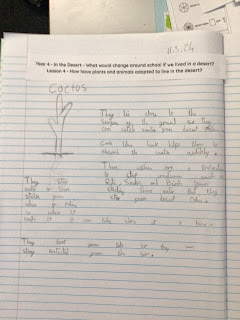
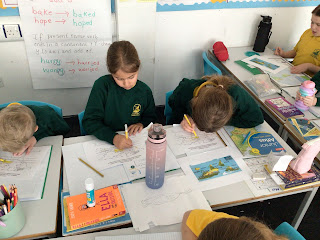
 This week, the children recapped their previous knowledge of the continents and oceans.  They then debated the words: habitat and adaptation. Some very interesting ideas. From there they researched how (using real cacti) cacti are able to live in the desert through their use of long roots system so they can gather up as much water as possible as it does not rain much in a desert. Furthermore, they have spikes on them instead of leaves to protect them from being eaten and animals sucking out its water.  Following on, the children looked at how a camel is able to live in the harsh conditions of a desert. Did you know that they have two sets of eyelashes? They can close their nostrils and their fur protects them from the sun as well as keeping them warm at night. 

What is the climate like in some deserts?

Image
 This week the children researched the difference between weather and climate.  Weather is what you see and feel right now and it changes very quickly.  Whereas, climate is what you expect to find in a place and it is measured over a long time: 30 years.  The children then  used an atlas as well as their knowledge of the Equator and the Tropics to find different countries that would have a hot climate and a cold climate.  Then, they studied a climate graph of the Sahara ( hottest desert in the world) and saw there was very little rainfall and the temperatures were quite high there as The Sahara is near the Equator. 

Where are most deserts found?

Image
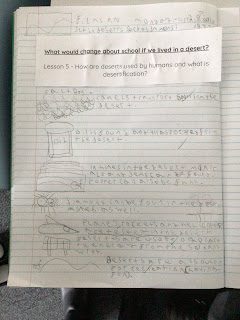
 This week, the children recapped the definition of a desert as well as understanding that not all deserts are hot. Then, they used their knowledge of the lines of latitudes: Tropic of Cancer, Equator and Tropic of Cancer. The children identified that the areas between the two lines of latitude is known as the Tropics. Here, the climate is hot and warm. There are not many clouds in the desert at night which means that the climate will be cold then. As we expect the climate to be warm there most of the deserts we looked at today are warm in the day. Following this the children used their atlases to locate different deserts in the world.  An amazing lesson year 4, lots of dojos handed out today. 
In the Desert

Image
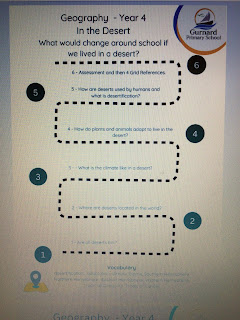
 This term, the children are learning all about deserts.  The children were introduced to the journey of knowledge for this unit.   Then , they were given 4 photos to discuss which one they thought was a desert and which weren’t. Some very interesting comments and ideas. Which ones do you think are deserts? All of these pictures show a type of desert.  Deserts receive less than 25cm or 250mm of precipitation a year. Using a ruler the class looked at how little that was. One child commented that we definitely don’t live in a desert as we have had more rain than that this year!he was correct as on average England has 1200mm of precipitation a year. A big difference. I 

What does The United Kingdom offer us?

Image
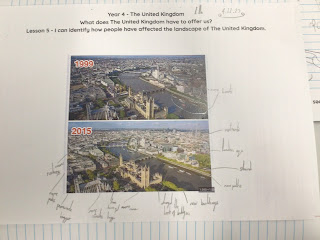
 This week, the children looked at two different aerial photos of London from 1999 and 2015. They discussed how man has changed the environment. They found new buildings, landforms as well as identifying how new roads, bridges, hotels and train lines have been built over the years to cope with the many people living in London and the tourists.  Lastly, they had to identify what The United Kingdom has to offer us. Some lovely work by all. 

What are the British Isles.

Image
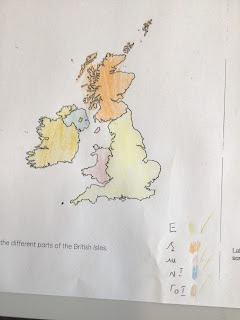
 Only one class completed the geography lesson this week as we had RE Day.  This week the children began identifying what parts make up the British Isles. They discussed why some parts are included in a geographical perspective such as Isle of Man and Ireland.  They then looked at the famous rivers and mountains in The United Kingdom and the children located them on a map. Some children discussed visiting the rivers and one child had even climbed Scafell Pike!